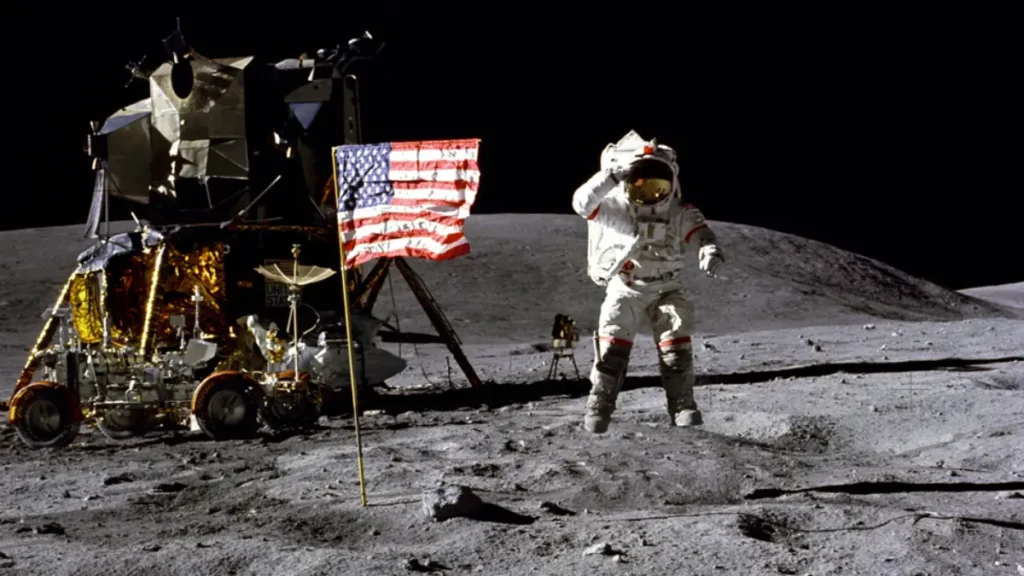
Fifty-six years after the Apollo 11 mission first brought humans to the Moon, the dream of returning is no longer just in the hands of astronauts and rockets—it now includes artificial intelligence (AI). As we commemorate the historic 1969 Moon landing, the question is no longer if we can go back, but how, and AI is becoming a critical part of the answer.
Unlike the Apollo era, today’s space missions rely on advanced algorithms, real-time data processing, and autonomous systems. AI can analyze vast amounts of data from satellites and rovers to select ideal landing sites, predict mechanical failures, and optimize flight paths with precision far beyond human capabilities.
NASA and private space companies are already integrating AI into their lunar plans. For example, intelligent robots can pre-map and build infrastructure on the Moon before astronauts arrive. AI systems also support mission control by detecting anomalies during launches or lunar operations, reducing human error and increasing safety.
One of AI’s greatest strengths is its ability to simulate and plan complex scenarios. Before a single rocket is launched, AI can run thousands of simulations to prepare for every possible outcome—something that would have taken years in the 1960s.
As we stand on the edge of a new space age, AI offers a powerful tool to help humanity return to the Moon—not just to visit, but to stay. With AI, we’re not merely repeating the past; we’re building on it, creating smarter, safer, and more sustainable missions.
The Moon landing at 56 reminds us of where we’ve been. AI shows us where we’re going. Together, they form a bridge between history and the future of space exploration.